The short version
- Shape clipped evergreen hedges in late spring to early summer, roughly May into June, after the new growth fills out.
- Save heavy cuts for early spring, before new growth starts.
- Stop hard cutting by mid-summer. Late growth may not harden off before winter.
- Yew can take a hard cut back into old wood. Arborvitae cannot, so stay in the green.
- Keep the top narrower than the base, or the bottom of the hedge goes bare.
Cut hard in early spring, shape by June, stop by mid-summer
Michigan State University Extension says many shrubs do well pruned in late winter or early spring, before new growth starts. Wisconsin and Penn State extension say the same for clipped evergreens, and add a later trim for shape. Iowa State University Extension's calendar starts shearing evergreen hedges in May through early June, just after the new flush of growth, and says to avoid extensive pruning after mid-summer.
| When | What to do | Why |
|---|---|---|
| Late winter to early spring | Heavy cuts and reshaping | New growth will cover the cuts |
| April into May | Cut out winter dead growth | New growth shows what survived |
| Late spring to early summer | The main shaping trim | The new growth has filled out |
| Mid-summer | A light second pass, if it needs one | Last call for the year |
| Late summer into early winter | Leave it alone | Late cuts raise the risk of winter injury |
Months from Iowa State University Extension's pruning calendar, with MSU, Wisconsin, Penn State and Minnesota guidance. A late or early spring moves these dates, so go by the plant.
Three common hedges, three different limits
Boxwood, yew and arborvitae are three of the most common clipped hedges, and each one wants something a little different.
| Plant | Shaping trim | Bigger cuts | How hard |
|---|---|---|---|
| Boxwood | Light shearing, spring to mid-summer | Dead growth out in early to mid-April | Keep it light and trim when dry |
| Yew | Around June, when leggy shoots show | Late March or early April, before growth | Takes a hard cut, slow to fill in |
| Arborvitae | Late spring to early summer | Spring, staying in the green | Bare brown wood will not regrow |
How far back you can cut depends on the plant
The calendars run close together. How hard you can cut is where the plants part ways.
- Boxwood is a light touch plant. Trim it when it is dry, since boxwood blight spreads on dirty tools and splashing water.
- Yew is the forgiving one. Among needled evergreens like arborvitae and juniper, Penn State Extension says only yews have dormant buds on old wood, so a hard cut can bring one back. Wisconsin says not to be afraid to cut a large overgrown yew back considerably, and to leave some small shoots on the limbs you cut. Expect it to look rough for a while.
- Arborvitae is a shaping plant, and Wisconsin says pruning it is usually for minor shaping, not major downsizing. It handles regular trims well as long as you stay in the green. Penn State says a cut back to bare brown wood will not regrow, and that branch will die.
- Junipers are the exception to shearing. Wisconsin says junipers and false cypress should not be sheared or cut back to older, non-leafy areas, because new growth takes years to hide the cuts.
- Lilac and forsythia run on a different clock. They set their flower buds the summer before, so MSU says to wait until right after they bloom. A trim in early spring cuts off the flowers.
A tall arborvitae hedge cannot simply be cut down to half its height and left to green up. Tell Jake how tall you want it, and he can say how far it will safely come down. There is more on tall and overgrown hedges under hedge trimming.
One safety note: Penn State says yew berries and foliage are poisonous to people and pets, which is one more reason to clean up the clippings.
Why hard cutting stops by mid-summer
Pruning pushes new growth, and growth that starts late in the season may not harden off before winter. University of Minnesota Extension says arborvitae, junipers, yews and hemlocks can be pruned until mid-summer. University of Wisconsin Extension says not to prune junipers and false cypress after August, for that same reason.
Fall is the wrong time for a hard cut, even if the hedge looks shaggy. Iowa State says fall pruned evergreens are more open to winter injury. If it has to look sharp for an event or a sale, ask Jake what a light tidy can do without setting the plant back. Our fall cleanup checklist covers what to do instead.
Keep the top narrower than the bottom
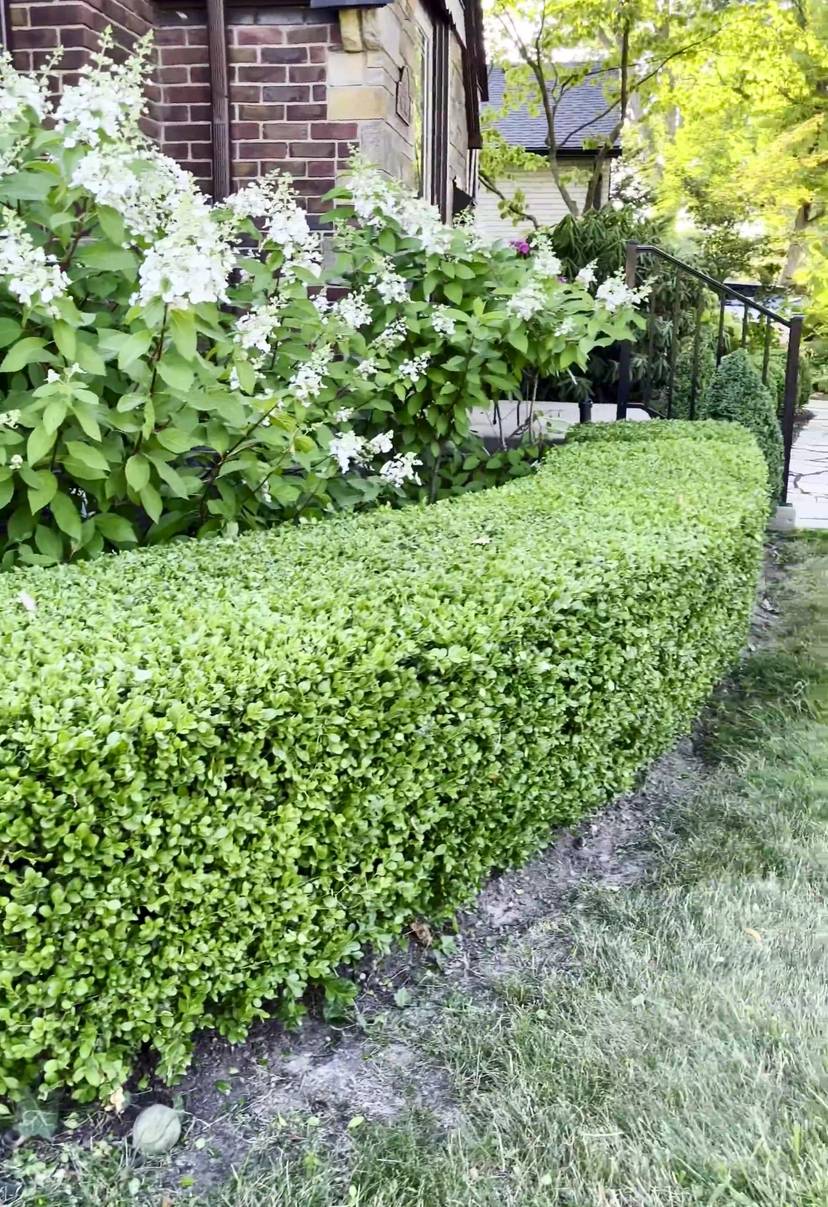
A hedge should be wider at the base than at the top. MSU, Penn State, Wisconsin and Minnesota extension all say so, because the slant lets sun reach the lower branches. Penn State describes the shape as an inverted V, and the top can be flat, rounded or pointed.
A hedge that is bare at the bottom usually got that way from a top wider than its base, which shades out the lower branches. The slant does not need to be dramatic. A slight taper is hard to notice from the sidewalk, and the bottom of the hedge will show the difference.
A formal hedge needs at least two trims a year
Iowa State University Extension says a formal evergreen hedge needs pruning at least twice a year, and that the tidiest hedges take it almost monthly. University of Minnesota Extension's version is spring and again in mid-summer. Penn State's is early spring with an optional light pass in summer. A loose, unsheared hedge needs far less.
We can do a one time trim, or work your hedges into monthly landscape maintenance.
Brown patches: look before you cut
Brown on a Michigan hedge can mean a few different things, and they do not all get the same fix.
- Winter damage. Wait for spring. Once new growth starts, a hedge can be pruned back to living shoots, and branches broken by snow get cut out clean.
- Boxwood blight. A fungal disease first found in Michigan in 2018. MSU says it can look like other problems, so have a sample checked by MSU Plant and Pest Diagnostics before you decide anything. Clean your tools between plants.
- Box tree moth. An invasive insect whose caterpillars chew boxwood leaves and leave webbing. Macomb, Oakland and Wayne counties are all inside Michigan's quarantine, which bars moving boxwood out of the area, clippings included.
If yours look off, show Jake at the walkthrough or text a photo to (586) 718-8762. Here is more on what to look for.
Where this comes from
- Michigan State University Extension, Spring Shape Up: Tidying Up Your Plants, Pruning Evergreen Shrubs, Tips on Tree and Shrub Pruning, and its articles on winter damage, boxwood blight and boxwood pests
- University of Wisconsin Extension, Pruning Evergreens, Pruning Planner for Evergreen Shrubs, and Winter Burn
- Penn State Extension, Pruning Needled Evergreens
- University of Minnesota Extension, Pruning Trees and Shrubs
- Iowa State University Extension, Proper Time to Prune Trees and Shrubs
- Michigan Invasive Species Program, Boxwood Blight, and Box Tree Moth, which lists the Michigan Department of Agriculture and Rural Development quarantine counties